Free Ebook Virtual Art: From Illusion to Immersion (Leonardo Books), by Oliver Grau
This is a few of the advantages to take when being the member as well as get guide Virtual Art: From Illusion To Immersion (Leonardo Books), By Oliver Grau right here. Still ask just what's various of the various other website? We provide the hundreds titles that are produced by recommended writers and also authors, all over the world. The link to purchase and download Virtual Art: From Illusion To Immersion (Leonardo Books), By Oliver Grau is additionally extremely simple. You may not discover the difficult website that order to do even more. So, the means for you to obtain this Virtual Art: From Illusion To Immersion (Leonardo Books), By Oliver Grau will be so simple, will not you?
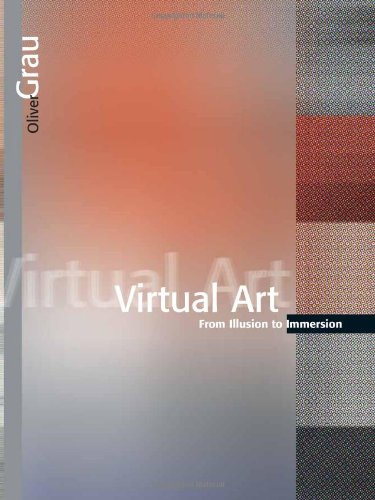
Virtual Art: From Illusion to Immersion (Leonardo Books), by Oliver Grau

Free Ebook Virtual Art: From Illusion to Immersion (Leonardo Books), by Oliver Grau
Virtual Art: From Illusion To Immersion (Leonardo Books), By Oliver Grau How a straightforward idea by reading can improve you to be a successful individual? Reviewing Virtual Art: From Illusion To Immersion (Leonardo Books), By Oliver Grau is a very easy task. However, just how can many individuals be so careless to read? They will prefer to invest their spare time to chatting or socializing. When actually, reading Virtual Art: From Illusion To Immersion (Leonardo Books), By Oliver Grau will certainly give you more probabilities to be successful finished with the efforts.
Occasionally, checking out Virtual Art: From Illusion To Immersion (Leonardo Books), By Oliver Grau is very monotonous as well as it will take long period of time starting from obtaining the book and also begin reading. Nonetheless, in contemporary period, you could take the creating technology by using the internet. By internet, you could see this web page and start to look for the book Virtual Art: From Illusion To Immersion (Leonardo Books), By Oliver Grau that is required. Wondering this Virtual Art: From Illusion To Immersion (Leonardo Books), By Oliver Grau is the one that you require, you could opt for downloading. Have you comprehended how to get it?
After downloading the soft data of this Virtual Art: From Illusion To Immersion (Leonardo Books), By Oliver Grau, you can begin to review it. Yeah, this is so delightful while someone needs to read by taking their huge publications; you remain in your new means by just manage your gadget. Or even you are working in the workplace; you could still use the computer system to check out Virtual Art: From Illusion To Immersion (Leonardo Books), By Oliver Grau completely. Certainly, it will certainly not obligate you to take numerous pages. Merely page by web page depending on the time that you have to review Virtual Art: From Illusion To Immersion (Leonardo Books), By Oliver Grau
After understanding this quite easy means to check out as well as get this Virtual Art: From Illusion To Immersion (Leonardo Books), By Oliver Grau, why do not you tell to others about this way? You could inform others to see this internet site as well as choose searching them preferred publications Virtual Art: From Illusion To Immersion (Leonardo Books), By Oliver Grau As understood, here are bunches of listings that supply lots of sort of publications to accumulate. Just prepare few time and also web connections to get guides. You can truly appreciate the life by reading Virtual Art: From Illusion To Immersion (Leonardo Books), By Oliver Grau in a really simple manner.
Although many people view virtual reality as a totally new phenomenon, it has its foundations in an unrecognized history of immersive images. Indeed, the search for illusionary visual space can be traced back to antiquity. In this book, Oliver Grau shows how virtual art fits into the art history of illusion and immersion. He describes the metamorphosis of the concepts of art and the image and relates those concepts to interactive art, interface design, agents, telepresence, and image evolution. Grau retells art history as media history, helping us to understand the phenomenon of virtual reality beyond the hype.
Grau shows how each epoch used the technical means available to produce maximum illusion. He discusses frescoes such as those in the Villa dei Misteri in Pompeii and the gardens of the Villa Livia near Primaporta, Renaissance and Baroque illusion spaces, and panoramas, which were the most developed form of illusion achieved through traditional methods of painting and the mass image medium before film. Through a detailed analysis of perhaps the most important German panorama, Anton von Werner's 1883 The Battle of Sedan, Grau shows how immersion produced emotional responses. He traces immersive cinema through Cinerama, Sensorama, Expanded Cinema, 3-D, Omnimax and IMAX, and the head mounted display with its military origins. He also examines those characteristics of virtual reality that distinguish it from earlier forms of illusionary art.
His analysis draws on the work of contemporary artists and groups ART+COM, Maurice Benayoun, Charlotte Davies, Monika Fleischmann, Ken Goldberg, Agnes Hegedues, Eduardo Kac, Knowbotic Research, Laurent Mignonneau, Michael Naimark, Simon Penny, Daniela Plewe, Paul Sermon, Jeffrey Shaw, Karl Sims, Christa Sommerer, and Wolfgang Strauss. Grau offers not just a history of illusionary space but also a theoretical framework for analyzing its phenomenologies, functions, and strategies throughout history and into the future.
- Sales Rank: #1206259 in Books
- Published on: 2003-01-17
- Original language: English
- Number of items: 1
- Dimensions: 9.00" h x 1.00" w x 7.00" l, 1.86 pounds
- Binding: Hardcover
- 360 pages
From Scientific American
The computer's ability to immerse a user in virtual image spaces "is not the revolutionary innovation its protagonists are fond of interpreting it to be," Grau writes. "The idea of virtual reality only appears to be without a history; in fact, it rests firmly on historical art traditions." Grau (lecturer in art history at Humboldt University in Berlin, associate professor at the Kunstuniversität Linz in Austria and leader of the German Science Foundation's project on immersive art) traces the lineage of virtual reality as far back as the frescoes of a villa in Pompeii. Many illustrations amplify the argument.
Editors of Scientific American
Review
Oliver Grau expands notions of immersion with a comprehensive overview of artistic meditations on illusion, presence and space. Using historical and innovative media-art project examples, he offers multiple perspectives on the evolution of our world-view. No doubt this volume will be a useful resource for any serious practitioner and/or theorist engaging the merging of art, science and technology.
(Victoria Vesna, Chair, Design and Media Arts, University of California)...a volume that will likely be used as a canonical text in the study of virtual reality...
(Patrick Lichty Intelligent Agent)Grau traces the lineage of virtual reality as farback as the frescoes of a villa in Pompeii.
(Scientific American)... Virtual Art: From Illusion to Immersion puts forth the sort of provocative insights that any Newromancer fan can appreciate.
(Wired)Oliver Grau has given us one of the more fascinating works this year.
(Guy Van Belle European Photography)The highly ambitious task of locating the latest image technologies within a wider art-historical context has now been accomplished.
(Friedrich Kittler, Humboldt University, Berlin, and author of Gramophone, Film, Typewriter)Grau's Virtual Art opens the door onto a significant new approach to media analysis by focusing in depth on a particular kind of digital art -- the attempt to create immersive environments. The combination of media archeology with careful analysis of both the possiblities and limitations of the impulse to put the viewer inside the artwork will make this book a valuable resource to both practitioners and theoreticians.
(Stephen Wilson, Professor of Conceptual and Information Arts, San Francisco State University, and author of Information Arts)Highly original...
(Alison Abbott Nature)Long established in Germany, media studies is just beginning to get hot in English-speaking countries. Grau's book makes a crucial contribution to this field by raising the bar for any future archeology of a virtual computer image. Equally at home in art history, media history, and new media art, Grau situates immersive image spaces of new media within a rich historical landscape. A must-read for anyone interested in new media, visual culture, art history, cinema, and all other fields that use virtual images.
(Lev Manovich, author of The Language of New Media) Language Notes
Text: English (translation)
Original Language: German
Most helpful customer reviews
16 of 16 people found the following review helpful.
Key Book
By A Customer
WIRED spoke about a "great read" and Lev Manovich decribed Grau's book as a "must-read for anyone interested in new media, art history, and any field using virtual images." - Grau lives up to expectations ! He analyzes what is new in media art by balancing recent works and historic media development, and so retells art history as media history. An interdisciplinary study in art history, media history, and new media art, the cross fertilization enriches his analysis and helps clarify the essence of immersion and Virtual Reality. Beyond Grau's analysis, I was thankful to see so many artists involved - many hot names. This book will be valuable for both practitioners and theoreticians. Hopefully there will be a paperback soon for students.
13 of 13 people found the following review helpful.
A Virtual Review of: Virtual Art: From Illusion to Immersion
By carrie
The unique approach to handing the history of `virtual art' is scholarly and innovative, undermining popular conceptions of the notion of `virtuality'. I would have appreciated colour plates, since the subject matter often pertains to the study of many forms of visual art. A glossary of terms also would have been helpful. The addition of these to elements would make the book much more accessible to readers who are introducing themselves to these concepts and artworks.
Broad in breadth and depth, Virtual Art: From Illusion to Immersion traces the history of virtual art through studying the history of `immersion' and `illusion' in the arts, and relates these ideas to the current developments in `virtual reality'. It is unlikely that the general public, or even most arts professionals, would consider the panoramic frescoes of ancient Pompeii a precursor to the 1980's notion of goggled cybernetic digitalia, nor the recent developments in transgenic art, yet this book includes very convincing arguments that link these ideas to the development of today's virtual art. Self-proclaimed as the `first' to link art history and immersive visual culture to the field of contemporary digital environment-based art experiences, this innovative and convincing research is laid out before the reader in an intellectual, yet accessible fashion, complete with diagrams and illustrations to illuminate key ideas. Many interesting works of art are chronicled here, placed within a contextual framework that demonstrates the significance of the ideas and technology supporting the works. Gathering this information in a print format also allows these works to live on and influence other thinkers outside of directly experiencing the works, which is often not technically possible, given the temporal nature of many immersion-based artworks. Ideas do not develop in a vacuum, but through the dialogues of overlapping discourses, combined with critical thought. Grau demonstrates that virtual art is not exactly new, and it satisfies a basic human desire for experiencing the `other', whether through looking at panoramic paintings of mythology or faraway lands, or designing a prototype Holodeck (Star Trek). Unexpected parallels abound, making this a very informative read that may forever change the reader's interpretations of classical art history as well as of virtual reality.
It is likely that Grau reaches the academic arts audience he sets out to reach with this book, as is demonstrated by the numerous references to this book online, in various journals, blogs, and academic websites. This focus on art history as media history would be thoroughly appreciated by Marshall McLuhan fans, as well as art historians who specialize in media studies. Artists and historians interested in 3-D modeling, avatar development, online immersive environments, transgenic art, and historical instances of illusion in the arts will also find this book a valuable and up-to-date resource. This book would make a welcome addition to a University library, a gallery or artist-run centre's library, or the personal collection of savvy technophiles.
0 of 1 people found the following review helpful.
Four Stars
By Kit A Galloway
It's just another book. Thanks!
Virtual Art: From Illusion to Immersion (Leonardo Books), by Oliver Grau PDF
Virtual Art: From Illusion to Immersion (Leonardo Books), by Oliver Grau EPub
Virtual Art: From Illusion to Immersion (Leonardo Books), by Oliver Grau Doc
Virtual Art: From Illusion to Immersion (Leonardo Books), by Oliver Grau iBooks
Virtual Art: From Illusion to Immersion (Leonardo Books), by Oliver Grau rtf
Virtual Art: From Illusion to Immersion (Leonardo Books), by Oliver Grau Mobipocket
Virtual Art: From Illusion to Immersion (Leonardo Books), by Oliver Grau Kindle

No comments:
Post a Comment